
Selling in Toledo? See every seller closing cost in Lucas County for 2026, from the...
Read MoreOhio is where the cash-flow math still works — and within Ohio, the question is which city actually delivers the best return on a dollar invested. This page makes the honest case, with numbers and a side-by-side comparison, for why Toledo leads the state on cash flow while conceding where the larger metros genuinely win.
One rule throughout: every figure here is a range. Prices, rents, and taxes move block by block, so use these as planning anchors and confirm current, neighborhood-level data before you act.

What Makes a True Cash-Flow Market
Before comparing cities, set the criteria. A real cash-flow market isn’t about a low sticker price alone — it’s about the relationship between what you pay and what the property earns, in a place where tenants stay. Four things drive it:
- Rent-to-price ratio. Monthly rent as a share of purchase price. The higher it is, the more room there is for profit after expenses. The 1% rule is the classic screen.
- Cap rate. Net operating income divided by price — your unleveraged yield. Low-entry markets tend to produce higher cap rates because prices are modest relative to rents.
- Low entry cost. Cheaper acquisition means less capital tied up per door and more capital efficiency, which matters enormously for BRRRR and for scaling a portfolio.
- Steady demand. Cash flow only counts if the unit stays rented. Stable employers and a consistent renter pool protect occupancy.
Judge any market — Toledo, Cleveland, Columbus, Cincinnati — against these four, and the picture gets clear fast. For the deeper math, see the Toledo ROI and numbers guide.

The Best Ohio Cities for Cash Flow
Ohio is one of the country’s most reliable regions for affordable rental property, which is why it draws out-of-state capital looking for yield the coasts can’t offer. Among the high cash-flow markets in Ohio, a few names come up again and again: Toledo, Cleveland, Columbus, Cincinnati, Dayton, and Akron.
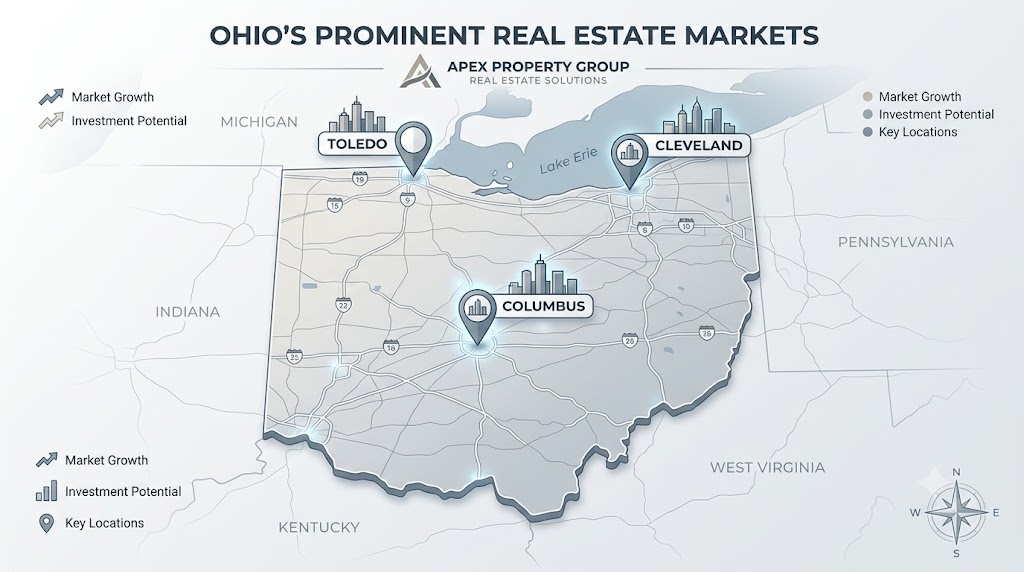
For most investors, the decision narrows to the three largest, most liquid markets with the deepest tenant pools: Toledo, Cleveland, and Columbus. Each has a different personality. Columbus is the growth story. Cleveland is the established cash-flow workhorse. Toledo is the low-cost, high-ratio market that’s still relatively under the radar — which is precisely where opportunity tends to hide.
Toledo vs Cleveland vs Columbus: The Comparison
Here’s an honest, investor-relevant comparison across the dimensions that decide a deal. Figures are qualitative ranges, not hard quotes — the point is the relative shape, which holds even as exact numbers move.
| Dimension | Toledo | Cleveland | Columbus |
|---|---|---|---|
| Typical entry price (SFR) | Lowest of the three — often well below the state median | Low — comparable to Toledo in many areas | Highest — strong-demand capital city |
| Rent-to-price ratio | Strongest — many areas approach or exceed 1% | Strong — broadly comparable | Compressed — prices have outpaced rents |
| Cash-flow potential | High | High | Lower — priced for growth |
| Investor competition | Lower — less saturated | Heavy — long-time investor target | Very heavy — institutional & national |
| Appreciation vs cash-flow lean | Cash-flow lean | Mixed | Appreciation lean |
The fair takeaway: Columbus is the better appreciation and scale play — if your thesis is long-term value and you can accept thin early cash flow, it’s a legitimate choice. Cleveland delivers cash flow comparable to Toledo, but its long history as an investor market means more competition for the best deals. Toledo wins on the cash-flow merits: the lowest capital per door, some of the strongest rent-to-price ratios in the state, and less crowding to fight through.
Why Toledo Leads Cash-Flow Real Estate in Ohio
Three forces make Toledo the standout for cash flow, and they reinforce each other.
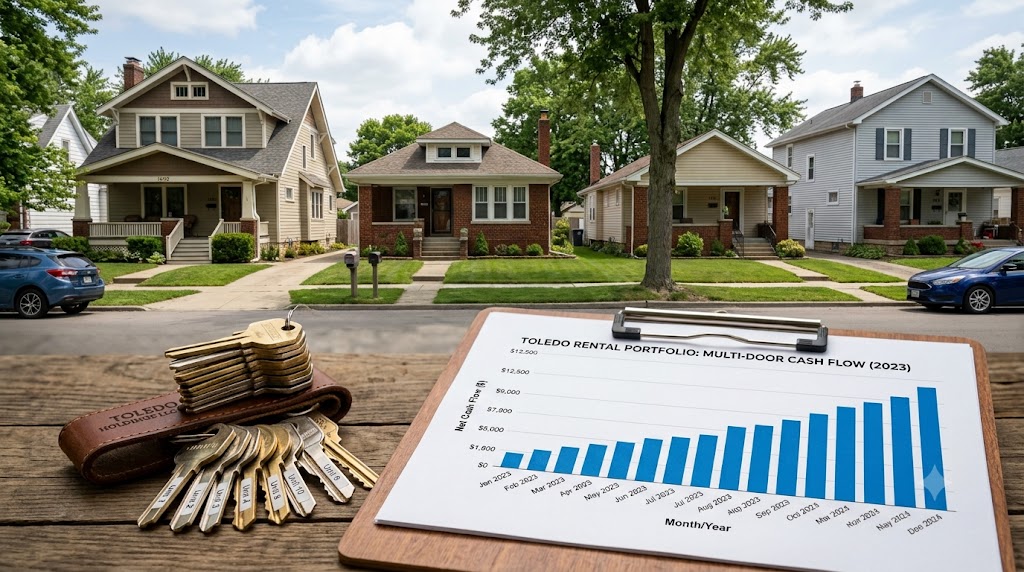
Affordability. Purchase prices for solid working-class single-family homes remain a fraction of coastal pricing and sit at the low end even within Ohio. Low entry cost is the foundation of every other advantage — it’s what produces wide rent-to-price ratios and capital efficiency.
Rent-to-price ratios. Because prices are low and rents are steady, many Toledo neighborhoods can approach or exceed the 1% benchmark — the gap where positive cash flow lives. That’s increasingly hard to find in higher-priced metros.
Steady, anchored demand. Toledo is home to ProMedica, a major regional healthcare system and employer, and the Jeep (Stellantis) Toledo Assembly Complex, a long-standing manufacturing anchor. Add the University of Toledo and a location between Detroit, Cleveland, and Chicago, and the renter pool stays deep. For the broader thesis, see is Toledo a good place to invest in real estate.

What This Means for Your Returns
Translate the market traits into your actual outcomes:
- Positive cash flow from day one is realistic when a deal is underwritten honestly — not a hope pinned on future appreciation.
- More doors per dollar. Low entry cost means the same capital buys more units, spreading vacancy risk and accelerating portfolio growth.
- Capital efficiency for BRRRR. Toledo’s spread between distressed acquisition and stabilized value lets you recycle capital deal to deal. See the BRRRR method explained for how that compounds.
- A defensible return. A deal built on real rents, taxes, insurance, and management costs is one you can defend to a lender, a partner, or yourself — not a best-case fantasy.
The trade-off to accept honestly: Toledo is a cash-flow market, not an appreciation rocket. If you need rapid equity growth above monthly yield, weigh that against a metro like Columbus. If you want durable income on efficient capital, Toledo is hard to beat.
How to Actually Capture It
Market averages don’t cash-flow — specific, well-underwritten deals do. Capturing Toledo’s advantage comes down to execution:
- Work with a local investor-agent who underwrites with real numbers and knows how class and block change the outcome — not just whoever has the listing.
- Buy vetted deals, screened on rent-to-price and stress-tested against vacancy, repairs, and CapEx before you ever make an offer.
- Use remote-buying support if you’re out of state: video walkthroughs, independent inspections, coordinated lender and title, and vetted local property management. The full workflow is in the out-of-state investors guide.
- Start from real inventory. Browse current opportunities across the greater Toledo communities and active listings.
FAQ
What is the best city in Ohio for cash flow real estate?
For pure cash flow, Toledo is consistently among the strongest in Ohio. It pairs some of the lowest entry prices in the state with rent-to-price ratios that in many neighborhoods approach or exceed the 1% benchmark, and it sees less investor saturation than Cleveland or Columbus. Columbus tends to win on appreciation and scale, but its higher prices compress cash flow. The right answer depends on your goals, so confirm current, neighborhood-level numbers before you commit.
Is Toledo better than Cleveland or Columbus for cash flow?
On cash flow specifically, Toledo usually leads. Cleveland offers comparable ratios but is a long-established investor target, so competition is heavier. Columbus is a strong growth market, but prices have outpaced rents, which lowers cash-flow yield. Toledo’s combination of low entry cost, solid rent-to-price ratios, and lighter competition is what makes it stand out for investors who think in cash flow rather than appreciation.
What rent-to-price ratio should I look for in Ohio?
The classic 1% rule — monthly rent at least 1% of purchase price — is a useful first screen, and many Toledo neighborhoods can approach or exceed it. Treat it as a filter, not a verdict: a strong ratio in an unstable area can underperform a modest ratio in a stable one once vacancy and repairs are included. Always underwrite with real taxes, insurance, and management costs.
What cap rate can I expect in Toledo?
Cap rates vary widely by neighborhood class, property condition, and management quality, so any single number would be misleading. Toledo generally offers higher cap rates than appreciation-driven metros because entry prices are low relative to rents. The honest way to know your number is to underwrite a specific property with real income and expenses rather than rely on a market average.
Why is Columbus not as good for cash flow?
Columbus is a genuinely strong market — but for appreciation and scale, not maximum cash flow. Years of population and job growth have pushed prices up faster than rents, which compresses yield and draws heavy institutional and out-of-state competition. That’s great if you’re buying for long-term value, but it makes day-one positive cash flow harder to find than in lower-cost markets like Toledo.
Can out-of-state investors buy cash-flow rentals in Toledo?
Yes, and most of Austin’s clients do exactly that. The process uses video walkthroughs, independent inspections, remote or e-notary closing, and vetted local property management lined up before closing, so the property cash-flows from day one. Many investors never visit Ohio until they choose to.
Get Toledo Cash-Flow Numbers That Pencil

Austin Cleghorn is a Toledo investor-friendly Realtor with 4+ years in this market, 500+ properties sold, and a 6-year U.S. Army background that shapes how he works: disciplined, numbers-first, and honest about which deals to walk away from. He underwrites every deal with real rents, taxes, insurance, and management costs, and helps out-of-state investors buy and run cash-flowing rentals remotely.
No pressure, no guesswork. If you want current, neighborhood-level Toledo cash-flow data and vetted deals that actually pencil, schedule a consultation and get a straight answer on whether Toledo fits your goals.