
Selling in Toledo? See every seller closing cost in Lucas County for 2026, from the...
Read MoreProperty taxes are one of the biggest fixed costs on a Toledo rental, and they are the number out-of-state buyers most often get wrong. This guide covers what you actually need: when Lucas County property taxes are due, how to pay them, what a typical bill looks like in Toledo and the suburbs, and how a 2025 Ohio law is raising taxes on rental property through 2029.
The short answer
Lucas County bills real estate taxes in two halves, one year in arrears. For tax year 2025, the first half was due January 31, 2026 and the second half was due July 31, 2026, according to the Lucas County Treasurer. Tax year 2026 bills are paid in 2027 on the same pattern. Using the Auditor's 2025 rates, a rental worth $100,000 in the Toledo City School District pays about $2,014 a year (about $168 a month). Rental owners should also budget for House Bill 186, which phases out the 10% non-business credit on residential property by tax year 2029, adding roughly 8% to a typical rental's bill if nothing else changes.
Jan 31, 2026
First-half 2025 taxes due
Lucas County Treasurer
Jul 31, 2026
Second-half 2025 taxes due
Lucas County Treasurer
62.12 mills
2025 effective residential rate, Toledo City / Toledo CSD
Lucas County Auditor, 2025 effective rates
~2.0%
Approximate annual tax as a share of market value for a Toledo CSD rental
Our calculation from Auditor rates
10% → 0%
Non-business credit on residential property, phased out tax years 2026–2029
Ohio HB 186
2028
Next scheduled Lucas County value update (moved from 2027)
13abc, January 2026
When Are Lucas County Property Taxes Due?
Ohio collects real estate taxes in arrears: the bills you pay in a calendar year cover the previous tax year. Lucas County splits each year's tax into two halves.
| Tax year | First half due | Second half due | Status |
|---|---|---|---|
| 2025 | January 31, 2026 | July 31, 2026 | Both halves now past due if unpaid |
| 2026 | Early 2027 (bills mail in January) | Mid-2027 (bills mail in summer) | Exact dates set by the Treasurer; check when bills mail |
Source: Lucas County Treasurer, Make a Payment, accessed October 2026. The Treasurer mailed second-half 2025 bills in July 2026 (Toledo Blade).
Two details matter for investors:
- The postmark decides whether a mailed payment is on time. The Treasurer notes that payments postmarked after the due date may be subject to penalties required by law.
- If your lender escrows taxes, the lender pays the bill. Cash buyers and owners without escrow are responsible for both halves themselves.
How to Pay Lucas County Property Taxes
| Method | Details | Fee |
|---|---|---|
| Online | Through the Treasurer's website (PaymentUS) with debit card, credit card, or eCheck | eCheck $0.50; cards 2.5% |
| Phone | 1-866-288-9803 | Card fees apply |
| Use the return envelope, payable to "Lucas County Treasurer," parcel number on the memo line | None | |
| In person | 5th Floor, One Government Center, Toledo, OH 43604, Monday to Friday, 8:00 a.m. to 4:30 p.m. | None for cash or check; card fees apply |
| Drop box | 640 Jackson Street, across from Government Center, 24 hours | None |
| Local banks | Participating WesBanco and Genoa Bank branches in January and July, exact bill amount only | None |
Source: Lucas County Treasurer. Treasurer's office: 419-213-4305.
The Treasurer also offers monthly and semi-annual automatic payment plans. For an investor without escrow, a monthly plan works like a self-managed escrow account and keeps a large July bill from landing on a vacant month.
How Your Tax Bill Is Calculated
The Lucas County Auditor lays out the math in four steps:
- Assessed value = 35% of market value. A home the Auditor values at $100,000 has an assessed value of $35,000.
- Multiply by the effective tax rate for the property's taxing district. Rates are quoted in mills (dollars per $1,000 of assessed value).
- Subtract credits such as the non-business credit, the owner-occupancy credit (owner-occupied homes only), and any homestead exemption.
- Divide by two for the first-half and second-half bills.
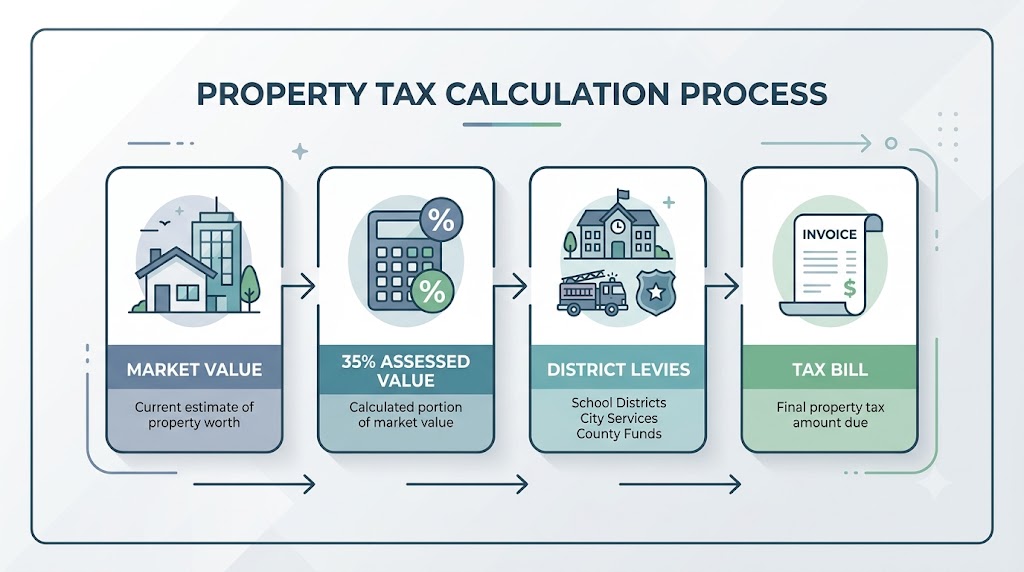
That is why there is no single "Toledo property tax rate." Two similar houses a few blocks apart can sit in different school districts and pay noticeably different amounts.
2025 Property Tax Rates by Area
The table below uses the Auditor's 2025 effective residential rates. The annual amounts are our estimates for a non-owner-occupied rental with a $100,000 Auditor value, after the 2025 non-business credit and before any special assessments.
| Taxing district | 2025 effective rate (mills) | Est. annual tax on $100,000 rental | Per month |
|---|---|---|---|
| Toledo City – Toledo CSD | 62.12 | $2,014 | $168 |
| Toledo City – Washington LSD | 63.89 | $2,067 | $172 |
| Toledo City – Sylvania CSD | 60.77 | $1,959 | $163 |
| Toledo City – Springfield LSD | 57.31 | $1,848 | $154 |
| Sylvania City – Sylvania CSD | 69.60 | $2,254 | $188 |
| Sylvania Township – Sylvania CSD | 71.88 | $2,325 | $194 |
| Maumee City – Maumee CSD | 70.66 | $2,290 | $191 |
| Oregon City – Oregon CSD | 52.86 | $1,701 | $142 |
| Washington Township – Washington LSD | 76.72 | $2,479 | $207 |
| Springfield Township – Springfield LSD | 66.65 | $2,174 | $181 |
| Ottawa Hills – Ottawa Hills LSD | 97.33 | $3,171 | $264 |
Rates: Lucas County 2025 Effective Tax Rates (Ag/Res column). Annual tax = $100,000 × 35% × rate ÷ 1,000, less each district's 2025 non-business credit factor. Estimates only; actual bills include special assessments and change every year. Perrysburg is in Wood County and is not shown.
To scale the table, multiply by your property's value in hundreds of thousands. A $150,000 rental in the Toledo City School District would pay roughly $3,021 a year at 2025 rates.
What Taxes Do to a Toledo Rental's Cash Flow
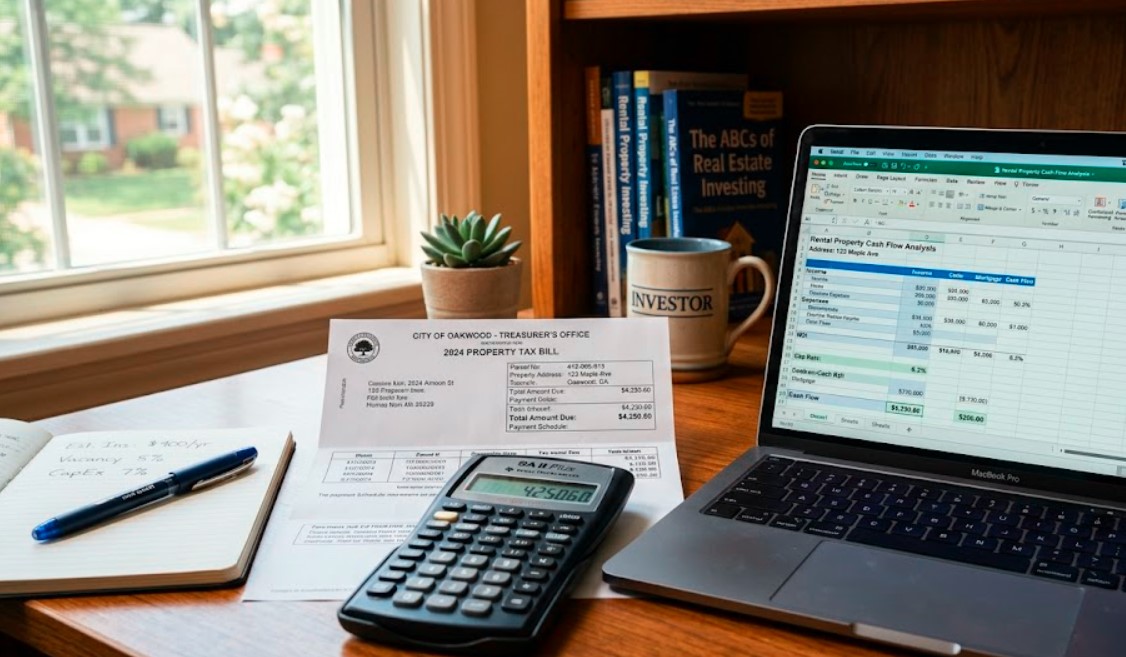
Here is how the tax line looks on a common Toledo purchase, using a $120,000 single-family rental in the Toledo City School District.
| Item | Amount |
|---|---|
| Auditor market value | $120,000 |
| Assessed value (35%) | $42,000 |
| Gross tax at 62.12 mills | $2,609 |
| Less 2025 non-business credit | −$192 |
| Estimated annual tax | $2,417 |
| Each half-year bill | $1,208 |
| Monthly reserve to set aside | $201 |
Our calculation from the Auditor's 2025 rates. Illustrative; confirm the actual bill for any parcel on AREIS.
Zillow puts the average three-bedroom rent in Toledo at about $1,250 a month (see our Toledo rental market report). On that rent, property taxes take roughly 16% of gross income before insurance, management, vacancy, repairs, or the mortgage. That is why taxes belong in the first pass of any underwriting, not the last. The full expense stack is covered in our Toledo cap rates and ROI guide.
Want the Real Tax Number on a Property?
Austin pulls the parcel's actual bill, district, and value history before you make an offer, so the tax line in your numbers is real.
Get a Property ReviewedNo pressure. No obligation.
HB 186: Why Rental Property Taxes Are Going Up
Ohio's property tax overhaul changes the credits that reduce your bill, and it treats rentals differently from owner-occupied homes. House Bill 186 took effect March 20, 2026. For investors, two parts matter:
- The 10% non-business credit is phased out for residential property. The credit drops to 7.5% in tax year 2026, 5% in 2027, 2.5% in 2028, and 0% in 2029 (Squire Patton Boggs summary; see also the Ohio School Boards Association). It stays at 10% only for non-timber agricultural land.
- The owner-occupancy credit rises from 2.5% to 15.38% by 2029. That offsets the change for people who live in their homes. A rental does not qualify for the owner-occupancy credit, so it absorbs the loss of the non-business credit with nothing offsetting it.
Using the 2025 rates above, losing the full non-business credit adds about 8% to a typical Lucas County rental's tax bill. On the $100,000 Toledo City School District example, that is roughly $2,014 rising to $2,174 a year by tax year 2029, before any levy or value changes. Tax year 2026 bills, which are paid in 2027, are the first to show the smaller credit.
HB 186 also created an Inflation Cap Credit for school districts at the state's 20-mill floor. It limits how much floor-district taxes can rise faster than inflation and first appears on second-half 2026 bills where it applies (Tucker Ellis summary). Whether a specific parcel benefits depends on its district, so check the bill rather than assuming a credit.
Underwriting tip: On any rental you plan to hold past 2029, model taxes at least 8% above the current bill. A deal that only cash-flows at today's tax number is thinner than it looks.
Property Values, the 2024 Revaluation, and Appeals
Ohio counties revalue property on a six-year cycle, with a smaller "triennial update" halfway through. Lucas County's last full revaluation was 2024, and it raised values sharply across the county (WTOL). The next update was scheduled for 2027 but has been moved to 2028.
What this means when you buy:
- Check the Auditor value against your price. If you pay far more than the Auditor's value, expect the gap to close at the next update, and underwrite the higher tax.
- You can challenge a value. Owners who believe a value is too high can file a complaint with the Lucas County Board of Revision. Ohio's annual filing window generally closes March 31; confirm current deadlines and forms with the Board before filing.
Taxes at Closing: Proration and the Conveyance Fee

Because Ohio taxes are paid in arrears, the seller usually owes taxes for time they owned the property that have not been billed yet. At closing, that amount is typically credited to the buyer on the settlement statement, and the buyer then pays the next bill when it arrives. The exact method follows your purchase contract and local title practice, so ask your title company to walk you through the tax proration line before you sign.
Lucas County also charges a conveyance fee of $4.00 per $1,000 of sale price, plus a $0.50 per-parcel transfer fee charged by the Auditor (Lucas County deeds brochure). On a $120,000 sale that is $480. In Ohio the seller customarily pays it, but it is negotiable. For every other cost on the settlement statement, see our guide to seller closing costs in Toledo.
Rental Registration With the County Auditor
Ohio law requires residential rental property to be registered with the county auditor. In Lucas County, if you own a livable property that is not your primary residence, you must file either a rental registration or an exception (Lucas County Auditor rental registration). Under Ohio Revised Code 5323.02, a new owner must register within 60 days after the conveyance form is filed, and failing to register can bring fines. Questions go to 419-213-4406 or rentalregistration@co.lucas.oh.us.
Inside Toledo city limits, most rentals built before 1978 also need a lead-safe certificate. That is a separate city requirement covered in our Toledo lead-safe ordinance guide.
How to Look Up Any Property's Taxes
- Open the Lucas County Auditor's AREIS property search.
- Search by address, owner name, or parcel number.
- Review the market value, assessed value, and taxing district on the parcel page.
- Open the tax tab to see the current bill, credits applied, special assessments, and payment status.
- Check whether the current bill includes an owner-occupancy credit or homestead exemption you will not inherit as a landlord.
Common Tax Mistakes Investors Make
- Underwriting from the seller's bill. An owner-occupant seller may receive the owner-occupancy credit or a homestead exemption. As a landlord you will not, so your bill will be higher.
- Ignoring HB 186. The non-business credit disappears for residential property by tax year 2029. Model the higher number.
- Forgetting special assessments. Street lighting, sewer, and other assessments appear on the bill and are not in the rate table.
- Missing rental registration. It takes minutes and avoids fines.
- Letting a half-year bill surprise you. Without escrow, set aside the monthly equivalent or use the Treasurer's monthly plan.
FAQ: Lucas County Property Taxes
When are Lucas County property taxes due?
Lucas County bills taxes in two halves, one year in arrears. For tax year 2025, the first half was due January 31, 2026 and the second half was due July 31, 2026, according to the Lucas County Treasurer. Tax year 2026 bills are paid in 2027 on the same pattern, with the exact dates printed on the bills and posted on the Treasurer's website.
How much are property taxes in Toledo, Ohio?
It depends on the taxing district and the Auditor's value. Using the 2025 effective rate of 62.12 mills for Toledo City and Toledo City School District, a rental valued at $100,000 pays about $2,014 a year after the non-business credit, or roughly 2% of value. Suburbs range from about $1,700 in Oregon to more than $3,100 in Ottawa Hills on the same value.
How is the Lucas County property tax bill calculated?
The Auditor sets the market value, and the assessed value is 35% of it. The assessed value is multiplied by the district's effective tax rate in mills, credits such as the non-business and owner-occupancy credits are subtracted, and the result is split into two half-year bills.
Do rental properties get the owner-occupancy credit?
No. The owner-occupancy credit applies only to a home the owner lives in as a primary residence. Residential rentals have received the 10% non-business credit, but House Bill 186 phases that credit out over tax years 2026 to 2029.
Will HB 186 raise taxes on my rental property?
Most likely, yes. HB 186 reduces the non-business credit on residential property to 7.5% for tax year 2026, 5% for 2027, 2.5% for 2028, and 0% for 2029, while raising the owner-occupancy credit that rentals do not receive. Using 2025 rates, losing the full credit adds about 8% to a typical Lucas County rental's bill, before any levy or value changes.
How can I pay Lucas County property taxes online?
The Lucas County Treasurer accepts online payments through PaymentUS by eCheck for a $0.50 fee or by debit or credit card for a 2.5% fee. You can also pay by phone at 1-866-288-9803, by mail, in person at One Government Center, or at the 24-hour drop box at 640 Jackson Street.
Do I have to register a rental property in Lucas County?
Yes. Ohio Revised Code 5323.02 requires residential rental property to be registered with the county auditor, and a new owner must register within 60 days after the conveyance is filed. Lucas County accepts registrations online or by mail through the Auditor's rental registration page.
Underwrite Your Next Toledo Rental With Real Tax Numbers
Taxes are one of the few costs you can know almost exactly before you buy, which makes them one of the easiest places to protect your returns. Pull the parcel, check the district, model the HB 186 change, and set aside the monthly reserve from day one.

If you are evaluating a Toledo-area rental, Austin can pull the actual tax bill, compare it with the Auditor's value and recent sales, and show you how it changes the cash flow before you make an offer.
Book a Free Investor Consultation
Disclaimer: This guide is general information, not tax or legal advice. Rates, credits, and due dates change every year. Confirm figures for a specific parcel with the Lucas County Auditor and Treasurer, and consult a tax professional for your situation.
Sources reviewed for this guide (October 2026)
- Lucas County Treasurer: Make a Payment (due dates, methods, fees)
- Lucas County: 2025 Effective Tax Rates
- Lucas County Auditor: Property Tax Information
- Lucas County Auditor: Real Estate Appraisal and Assessment
- Lucas County Auditor: Rental Registration
- Ohio Revised Code 5323.02
- Squire Patton Boggs: Update on Real Property Tax Reform (HB 186 credit schedule)
- Ohio School Boards Association: HB 186 summary
- Lorain County Auditor: HB 186 FAQ
- Tucker Ellis: Four New Ohio Property Tax Laws
- 13abc: Lucas County property revaluation schedule to change (January 2026)
- Lucas County: Deeds Brochure (conveyance fee)