
Selling in Toledo? See every seller closing cost in Lucas County for 2026, from the...
Read MoreToledo, as a city, is a strong cash-flow market - that part is well established. What’s less understood is that ROI varies significantly block by block, not just city by city, which is exactly why searching for the best zip codes for rental investment in Toledo is the right instinct. Two properties ten minutes apart can produce very different returns once you account for real rent-to-price ratios, tenant stability, and taxes.
This isn’t a ranked list of ZIP codes with numbers attached - those change, and they’re part of the current data set Austin maintains for clients. What follows is the actual framework: the factors that separate strong-performing areas from weak ones, so you can evaluate any Toledo ZIP code the way an experienced investor-agent does, whether you’re comparing two listings side by side or narrowing down where to start looking in the first place.
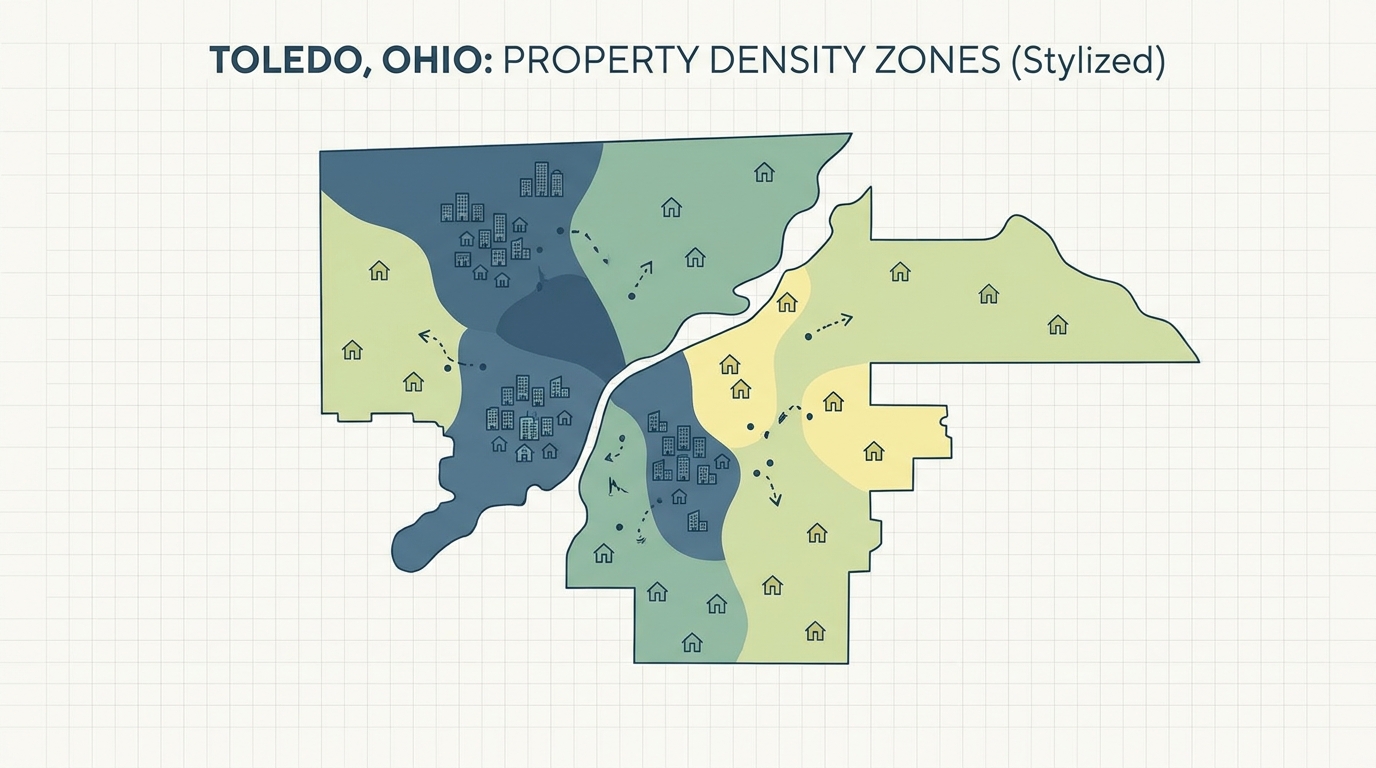
Why “Toledo Is Cheap” Isn’t a Strategy
“Toledo is affordable, so it must cash flow” is where a lot of first-time market research stops - and it’s not wrong exactly, just incomplete. Affordability is the reason Toledo is on the map at all; it’s not the reason one property outperforms another within the city.
Toledo rental ROI by zip code depends on the same underwriting discipline you’d apply to comparing cities, just at a finer resolution. Two ZIP codes can share a similar median price and produce meaningfully different returns once rent levels, tenant stability, and taxes are accounted for. Treating the whole city as one undifferentiated opportunity is how investors end up in a property that looked cheap on paper and performs poorly once the real numbers are in.
The 5 Factors That Drive ZIP-Level ROI in Toledo
Run every area through the same five checks, regardless of what the price tag suggests. None of these factors work as a standalone score - they interact, and the combination is what actually predicts performance.
- Entry price vs. rent. The relationship between purchase price and achievable rent - the rent-to-price ratio - not the price in isolation.
- Neighborhood class. The general A-D tendency of the area, which shapes tenant stability far more than the ZIP code label itself.
- Employer / demand proximity. Distance to anchors like major hospitals, manufacturing employers, or universities that keep a renter pool consistent.
- Property tax burden. Rates and levies vary by taxing district, and taxes are a top-line fixed cost that directly erodes cash flow.
- Vacancy / turnover tendency. How often units in the area typically turn over, since every vacant month is lost income regardless of the on-paper ratio.
None of these live in isolation - a great rent-to-price ratio in an area with high turnover can underperform a modest ratio somewhere stable. That interaction is exactly what a framework, not a single number, is built to capture.
What Actually Drives ROI Differences Between Toledo ZIP Codes
Here’s the framework laid out as a table - what to check for any ZIP code, described categorically rather than as a ranked list with invented figures.
| Factor | What to look for | Tendency in stronger-performing areas |
|---|---|---|
| Entry price range | Low, mid, or higher relative to the metro | Often low-to-mid, not necessarily the lowest |
| Tenant demand driver | Proximity to employers, hospitals, universities | Closer proximity, consistent local employment |
| Neighborhood class tendency | General A-D lean of the area | Solid B-class most often; occasional strong C |
| Vacancy risk tendency | How often units typically turn over | Lower and more predictable turnover |
| Cash-flow potential tendency | Strong, moderate, or weak once fully underwritten | Strong, but only after real expenses are included |
This is a checklist, not a scoreboard - use it to evaluate any specific ZIP code or property you’re considering, rather than treating it as a ranking of named areas.
What High-ROI Areas Tend to Have in Common
Without naming specific ZIP codes, a consistent pattern shows up across Toledo’s stronger-performing pockets:
- Older, well-maintained single-family housing stock that’s solid enough to rent without extensive rehab, keeping entry cost reasonable relative to rent.
- Proximity to major employers - areas near anchors like ProMedica or the Jeep (Stellantis) Toledo Assembly Complex tend to see steadier tenant demand than areas without a nearby employment base.
- Strong, defensible rent-to-price fundamentals - not the lowest price in the city, but a favorable relationship between what a property costs and what it rents for.
- A location between Detroit, Cleveland, and Chicago that supports broader regional demand, reinforcing the city-level case laid out in why Toledo works for cash flow.
These are patterns, not promises - every property still needs its own underwriting. The city-level fundamentals behind this pattern are covered in is Toledo a good place to invest.
Want a specific property or area evaluated?
Get real numbers on a property you're considering, underwritten the same disciplined way.
Book a Free ConsultationNo pressure. No obligation.
The Trap of Chasing the Cheapest ZIP Code
The lowest entry price in the city is tempting precisely because it’s easy to find and easy to understand. It’s also frequently the wrong target for highest cash flow areas in Toledo, because the lowest price often comes bundled with the highest vacancy risk and turnover.
Here’s the mechanism: a property with a great rent-to-price ratio on paper can still underperform if the unit sits vacant for months between tenants, or if turnover costs (make-ready, re-leasing, lost rent) recur every year instead of every three or four. Paper cash flow assumes full occupancy; real cash flow doesn’t. The cheapest ZIP code frequently trades a strong ratio for weaker occupancy - and the math only works if you underwrite both sides honestly.
This is also where a cheap purchase price can be misleading in a second way: lower-priced areas sometimes carry heavier property management demands, since more turnover means more leasing cycles, more make-ready work, and more day-to-day oversight. That added management burden is a real cost even when it doesn’t show up as a line item on the listing. A property that costs slightly more but rents steadily to long-term tenants can be the better investment even though it looks less impressive on a first-pass ratio calculation.
How This Ties to Neighborhood Class
ZIP codes are administrative boundaries; they don’t always align neatly with tenant stability or property condition. That’s where neighborhood class - commonly discussed as an A through D framework - adds resolution that a ZIP code alone can’t. A single ZIP code can contain a mix of classes across different blocks.
Think of it as two lenses: ZIP-level data is a useful first filter for narrowing your search, and neighborhood class is the finer-grained check once you’re looking at a specific block or property. For a deeper look at how the A-D framework works in practice, see the class breakdown within the guide to buying rental property in Toledo.
How to Get Current, ZIP-Specific Numbers
Everything above is the framework - the actual thinking process. What it deliberately doesn’t include is a current, ranked list of Toledo ZIP codes with real rent-to-price ratios and ROI figures, because that data changes and it’s not something to freeze in a blog post and call current a year later.
For current, ZIP-level numbers, Austin pulls fresh rent and sale comparables for the specific area or property you are considering, so you are working from this month's data rather than a stale snapshot. For citywide rent and price trends, see the Toledo rental market report.
Want Current Numbers for a Specific Area?
Austin can pull current rent and sale comparables for any Toledo ZIP code or property you are considering.
Request Area NumbersNo pressure. No obligation.
If you’d rather talk through a specific property or area directly, a consultation covers that too - see current opportunities across the greater Toledo communities and active listings, or review the underwriting approach in the ROI and numbers guide. For remote buyers, the out-of-state investors guide covers how this all works from a distance.
FAQ
How do I know which Toledo ZIP code is best for cash flow?
Evaluate each area on the same factors every time: the rent-to-price ratio for that specific pocket, the neighborhood class and how stable it tends to be, proximity to major employers or institutions that anchor tenant demand, the property tax burden, and typical vacancy or turnover tendency. No single factor tells the whole story - a ZIP code that looks cheap can still underperform if turnover or taxes eat the margin. Current, property-level numbers matter more than any generalization, which is why real underwriting on a specific address beats a citywide assumption.
Do higher-priced Toledo ZIP codes have better ROI?
Not necessarily, and often the opposite is true for cash-flow investors. Higher-priced areas can offer more stability and lower turnover, but the rent-to-price ratio - the relationship that drives cash flow - is frequently stronger in more moderately priced, well-maintained areas. Chasing the highest price assuming it means the best return skips the actual math. Chasing the lowest price does too, if it ignores vacancy and turnover risk. The ratio matters more than the price tier alone.
How often does Toledo’s rental market shift by area?
Meaningfully enough that a snapshot from a year or two ago shouldn’t be treated as current. Rent levels, price points, and even neighborhood trajectory can shift within a market as employers expand or contract, levies change tax burdens, and specific blocks improve or decline. This is exactly why ZIP-level investment decisions should be based on current data rather than a general impression of an area formed at some point in the past.
Is the cheapest ZIP code in Toledo the best for investors?
Rarely, once you account for the full picture. The lowest entry price often comes from higher vacancy risk, more turnover, and heavier property management demands, all of which can quietly erase the cash flow that looked strong on paper. A moderately priced area with a stable tenant base and manageable turnover frequently outperforms the cheapest option once real operating costs are included.
What’s the difference between ZIP code data and neighborhood class?
ZIP codes are administrative boundaries and can contain a mix of neighborhood conditions within the same few digits. Neighborhood class (commonly discussed as A through D) is a more granular way of describing block-level tenant stability, property condition, and income tendency, and it can vary meaningfully within a single ZIP code. Strong ZIP-level fundamentals are a starting filter; neighborhood class and block-level diligence refine the picture from there.
Get the Current Data or Talk Through a Property

Austin Cleghorn is a Toledo investor-friendly Realtor with 4+ years in this market, 500+ properties sold, and a 6-year U.S. Army background. He sources on- and off-market properties across many Toledo areas and underwrites every deal with real rents, taxes, rehab, and projected ROI - the same discipline behind the framework above.
No pressure, no guesswork. Schedule a consultation to get current numbers for a specific Toledo ZIP code, area, or property.