
Selling in Toledo? See every seller closing cost in Lucas County for 2026, from the...
Read More“Neighborhood class” gets mentioned constantly in investing content, often assumed rather than explained. Toledo neighborhood classes for investors are a framework - A, B, C, and D - for describing property condition, tenant profile, and the risk/return trade-off of a rental, and understanding it well is one of the most transferable skills you can build as an investor, in Toledo or anywhere else. Get this framework right and you can evaluate almost any rental property with real confidence, not just a gut feeling from a listing photo.
This article explains what each class actually means, how the trade-offs really work, and how to assess a property’s class yourself. It stays focused on the framework itself - for the location-specific ROI factors like entry price and employer proximity, see the companion piece on Toledo rental ROI by ZIP code. Together, the two pieces cover the full picture: where to look, and what you’re actually looking at once you get there.
A note on language: Class describes property condition, market dynamics, and investment risk - never the people who live in an area. Treat it as a tool for evaluating buildings and blocks, not a judgment about residents.
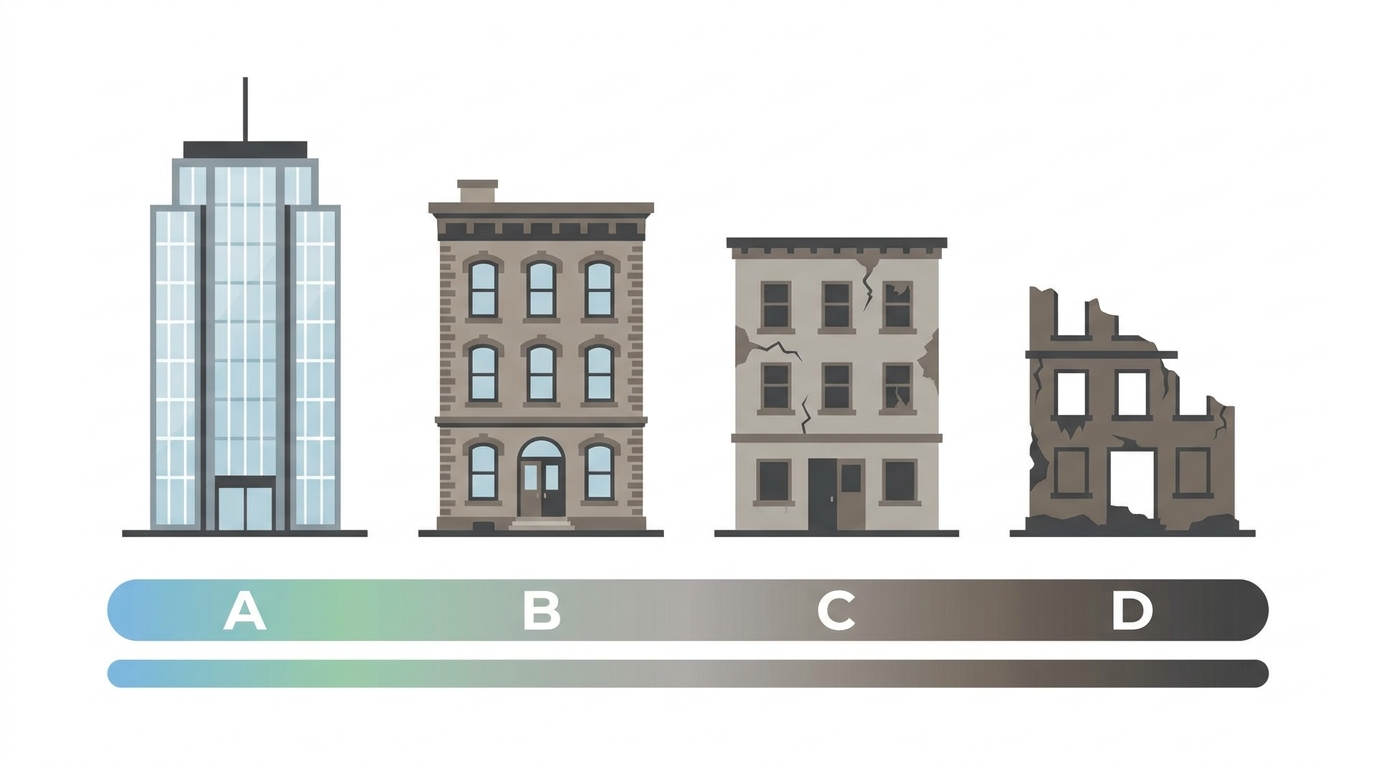
What Neighborhood Class Actually Measures
The A/B/C/D system is shorthand investors use to communicate quickly about a property type, but it’s built from a few concrete, measurable factors:
- Property condition and age - how well-maintained the housing stock tends to be.
- Tenant demand and turnover patterns - how quickly units in the area typically lease and how long tenants tend to stay.
- Risk and return trade-off - the balance between stability and yield you can generally expect.
- Management intensity - how much hands-on attention a property in that class typically requires to perform well.
It is a tool for evaluating buildings and market segments, not a judgment about the people who live in a given area. Every class fits a different strategy - none is inherently “good” or “bad” in isolation.
A
A-Class Explained
Typical condition: Newer or premium, well-maintained properties, often in higher-demand areas with strong overall upkeep.
Typical tenant profile: Longer-tenured, stable tenants with strong rental and income history.
Risk/return trade-off: Highest stability, lowest turnover - but typically the lowest cash-on-cash yield relative to purchase price, since you’re paying a premium for the stability.
Who it suits: Investors prioritizing low management involvement and long-term stability over maximum monthly cash flow, often appreciation-leaning buyers.
B
B-Class Explained
Typical condition: Solid, well-kept, working-to-middle-class housing stock, generally older than A-class but consistently maintained.
Typical tenant profile: Reliable tenants with steady employment, moderate turnover.
Risk/return trade-off: A genuine balance point - strong stability with a more attractive yield than A-class, and meaningfully less management intensity than C-class.
Who it suits: Most first-time and out-of-state investors, and anyone who wants dependable performance without heavy hands-on involvement. This is frequently where turnkey rental properties in Toledo tend to fit well.
C
C-Class Explained
Typical condition: Older housing stock, often needing some updating, in working-class areas with more variability block to block.
Typical tenant profile: More turnover than B-class; tenant quality varies more and requires more thorough screening.
Risk/return trade-off: Often the strongest cash-on-cash returns of any class relative to entry price - C-class rental property investing is genuinely attractive on paper, but that yield comes with real, ongoing management demands.
Who it suits: Active, hands-on investors, or those working with strong local property management who can absorb the extra turnover and maintenance without it eroding returns. Often the honest “sweet spot” for experienced cash-flow investors, precisely because most casual buyers avoid it and competition is lighter. That lighter competition is itself part of the return: fewer investors bidding on C-class deals often means better entry prices relative to what the property can actually produce.
D
D-Class Explained
Typical condition: Distressed pockets, higher vacancy, and inconsistent upkeep across the block.
Typical tenant profile: Highest turnover and the least predictable tenant demand of any class.
Risk/return trade-off: The highest theoretical yield on paper, but also the highest real risk - vacancy, turnover, and maintenance costs frequently erase the advantage a low entry price seems to offer.
Who it suits: Generally, very experienced, hands-on operators with deep local knowledge and support - not remote or passive investors. Most out-of-state and first-time buyers should approach D-class with real caution, if at all.
Not sure what class a specific property is?
Get an honest, local assessment before you make an offer - not a guess from listing photos.
Book a Free ConsultationNo pressure. No obligation.
A vs. B vs. C vs. D Class Properties: Investor Comparison
Here’s the full comparison side by side. Columns are qualitative and directional. For current Toledo rent figures by neighborhood, see the Toledo rental market report.
| Factor | A-Class | B-Class | C-Class | D-Class |
|---|---|---|---|---|
| Property condition / age | Newer, premium, well-kept | Solid, older but maintained | Older, often needs updating | Distressed, inconsistent upkeep |
| Typical tenant profile | Long-tenured, stable | Reliable, steady employment | More variable, needs strong screening | Highest turnover, least predictable |
| Vacancy / turnover tendency | Lowest | Low to moderate | Moderate to higher | Highest |
| Management intensity | Low | Low to moderate | Higher - active management matters | Highest - intensive, local, hands-on |
| Appreciation vs. cash-flow lean | Appreciation-leaning | Balanced | Cash-flow leaning | Cash-flow leaning, high risk |
| Ideal investor type | Hands-off, stability-focused | First-time / out-of-state, passive | Active cash-flow investor | Experienced, hands-on local operator |
No row declares a single “winner” - the right class depends entirely on your goals, capital, and how hands-on you want to be.
Matching Class to Your Strategy
Class isn’t just descriptive - it should actively shape which properties you target:
- Turnkey and passive investors generally lean B-class, where stability and lower management demand align with wanting a hands-off hold.
- Active BRRRR and value-add investors often target C-class, where forced appreciation and stronger cash-on-cash returns reward the extra management effort. See the BRRRR method explained for how that strategy pairs with class selection.
- D-class is rarely the right starting point for remote or first-time investors - the management intensity and risk profile usually outweigh the paper yield unless you have serious local support.
Matching class to strategy - not chasing the highest theoretical return in isolation - is what separates investors who build a sustainable portfolio from those who get burned by a great-looking ratio in the wrong class. For how this fits into full deal underwriting, see the ROI and numbers guide and why Toledo works for cash flow.
How to Assess a Property’s Class in Toledo
You don’t need to guess. A property’s class becomes clear by checking a consistent set of signals:
- Housing stock age and condition on the specific block, not just the listing photos of one property.
- Block-level patterns - upkeep of neighboring properties, visible vacancy, and general maintenance level nearby.
- Tenant demand signals - how quickly comparable units in the immediate area typically lease.
- Turnover history for the specific property, if available, rather than assumptions based on price alone.
A useful pattern to know: B-class areas often surround strong C-class cores, and class can shift meaningfully within just a few blocks. That’s exactly why a citywide or even ZIP-level generalization isn’t enough - class assessment has to happen at the property and block level, ideally by someone with direct local market experience.
In practice, this means driving the block (or getting a real video walkthrough of it if you’re buying remotely), not just the property itself. A well-renovated house can still sit in a block where every other property tells a different story, and that surrounding context matters as much as the four walls you’re underwriting.
Where to Get Toledo’s Actual Class-by-Class Data
Everything above is the framework - what each class means and how to think about it. What it deliberately doesn’t include is Toledo-specific rent ranges, price points, and cash-flow numbers by class, because those are current, local-market figures that shouldn’t be frozen into a blog post and treated as fact a year later.
For current numbers, start with the neighborhood rent figures in the Toledo rental market report and the location factors in the Toledo rental ROI by ZIP code companion piece. For a specific property, Austin can pull current rent and sale comparables and give an honest read on its class.
Want Real Numbers for a Specific Property?
Austin can pull current rent and sale comparables and assess the property’s class before you make an offer.
Request a Property ReviewNo pressure. No obligation.
FAQ
What does C-class property mean in real estate?
A C-class property is typically an older building in fair to good condition, often needing some updating, located in a working-class area with more tenant turnover than A- or B-class. It’s a description of the property and market segment, not the people who live there. C-class often delivers stronger cash-on-cash returns than higher classes, but it requires more active, hands-on management to perform well.
Which neighborhood class is best for first-time investors?
For most first-time and out-of-state investors, B-class tends to be the more forgiving starting point. It generally balances reasonable cash flow with lower management intensity and more predictable tenant behavior than C-class, without the high entry cost and lower yield typical of A-class. The right answer still depends on your goals, capital, and how hands-on you want to be.
Is B-class or C-class better for cash flow?
C-class often produces stronger cash-on-cash returns because entry prices are lower relative to achievable rent. B-class typically produces more stable, predictable cash flow with less turnover and management demand. Neither is universally better - C-class rewards investors willing to manage more actively or pay for strong property management, while B-class suits those who want steadier, lower-effort returns.
Should out-of-state investors buy D-class property?
Generally, no - or only with extreme caution and strong local, hands-on support. D-class carries the highest vacancy, turnover, and management intensity of any class, which is difficult to manage well from a distance. Most remote and passive investors are better served by targeting B- or C-class properties, where the risk profile is more manageable without daily local oversight.
How is neighborhood class actually determined?
Class is assessed by looking at housing stock age and condition, block-level patterns like upkeep and vacancy, and tenant demand signals such as how quickly units in the area typically lease. It’s a directional framework built from local knowledge and current data, not an official designation, which is why real, current class assessment for a specific property benefits from someone with direct local market experience.
Get the Data or Assess a Specific Property

Austin Cleghorn is a Toledo investor-friendly Realtor with 4+ years in this market, 500+ properties sold across a range of Toledo areas and classes, and a 6-year U.S. Army background. He underwrites every deal with real rents, taxes, rehab, and projected ROI - including honest assessment of class-driven risk, rather than overstating what a property can realistically return.
No pressure, no guesswork. Schedule a consultation to assess a specific property’s class with current rent and sale comparables.