
Landlord insurance for Ohio rental property, explained: what it covers, how it differs from homeowners...
Read More"Should my next Toledo rental be a single-family home or a duplex?" is one of the most common decisions investors face, right after deciding to invest in the first place. The honest answer depends less on which property type is "better" and more on how much capital you have, how much income risk concentration you are comfortable with, and what you want your portfolio to look like a few years from now.
This guide compares single family vs multifamily investing in Toledo, Ohio, across income risk, financing, management, cash flow, and resale liquidity, so you can make the call for your specific situation rather than following a rule of thumb you read somewhere else.
In This Guide
- The Core Trade-Off: Income Concentration vs. Diversification
- Financing Differences: What Actually Qualifies as Residential
- Single Family vs Multifamily Investing in Toledo: The Comparison Table
- Management Realities: More Doors, More Efficiency, More Moving Parts
- Cash Flow Potential: How the Math Tends to Differ
- Exit Strategy and Liquidity Differences
- Which Should You Buy First? A Practical Decision Framework
- How This Fits Into a Broader Portfolio Strategy
- FAQ
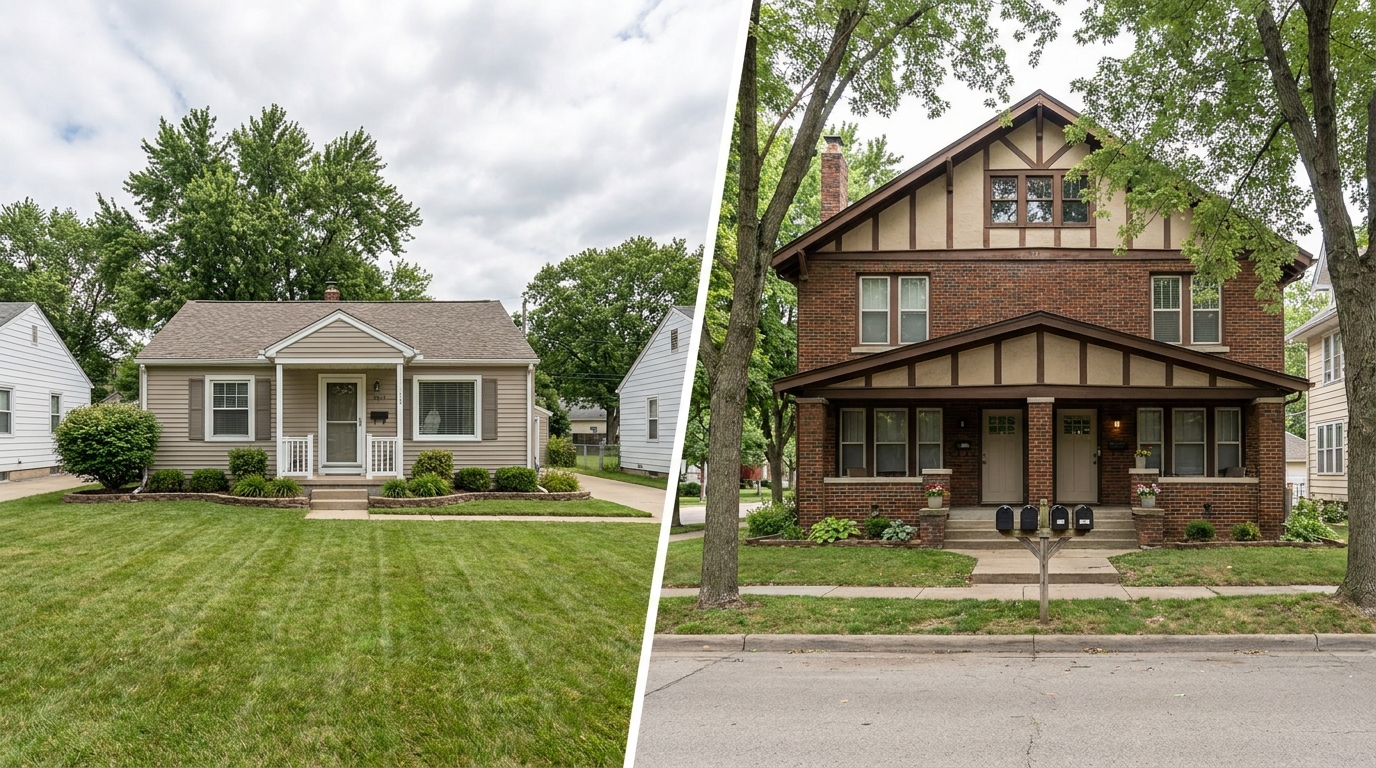
The Core Trade-Off: Income Concentration vs. Diversification
A single-family rental is an all-or-nothing income stream. One vacant unit means one hundred percent of that property's income is gone until a new tenant moves in. There is no partial version of a vacant single-family home.
A small multifamily property, meaning a duplex, triplex, or fourplex, spreads that same risk across multiple units under one roof and one mortgage. If one unit goes vacant, the others are typically still generating rent, so the property rarely produces zero income at once the way a vacant single-family home does.
This is the single biggest structural difference between the two property types, and it is worth understanding before anything else, since it shapes how each one behaves during a bad month, not just a good one.
Financing Differences: What Actually Qualifies as Residential
Both single-family homes and small multifamily properties up to four units typically qualify for residential-type financing, not commercial. This distinction matters more than most new investors realize. Residential loans, whether conventional or DSCR, tend to have more accessible qualification standards and a more straightforward process than the commercial financing required once a property crosses into five or more units.
Some buyers, particularly local, owner-occupant investors, use a duplex, triplex, or fourplex for house hacking duplex strategies, living in one unit while renting out the others. This can open up owner-occupant financing terms not available on a pure investment purchase. Most of this site's audience is out-of-state and buying as a non-owner-occupant, so house hacking usually is not on the table, but it is worth knowing the option exists for local buyers weighing their first purchase.
For the fuller breakdown of financing options across both property types, including DSCR loans specifically, see our financing a rental property out of state guide.
Single Family vs Multifamily Investing in Toledo: The Comparison Table
Reading about each property type separately only gets you so far. The single-family vs. multifamily investing in Toledo, Ohio decision becomes a lot clearer once you see both side by side, across the factors that actually shape day-to-day ownership.
| Factor | Single-Family | Small Multifamily (2-4 Unit) |
|---|---|---|
| Typical Entry Price | Generally lower, and often the more accessible starting point. | Generally higher, since you are buying multiple units in one purchase. |
| Vacancy Risk | Concentrated. One vacant unit means one hundred percent of the property's income is gone. | Distributed. One vacant unit is a partial loss, not a total one, since other units typically keep generating rent. |
| Financing Options | Residential financing, including conventional and DSCR loans. | Also residential financing up to four units, including conventional and DSCR loans, not commercial. |
| Management Complexity | Simpler on average. One tenant relationship, one unit to maintain per property. | More efficient per unit in some ways, but more simultaneous tenant issues, since more households are under one roof. |
| Tenant Pool and Turnover | Tenants often stay longer on average and can treat the home more like their own. | Turnover tendencies vary more by unit and property, often somewhat higher than single-family on average. |
| Resale Liquidity | Typically higher. A larger buyer pool, including owner-occupants, not just investors. | Typically lower. A smaller, more investor-specific buyer pool, with value tied more directly to income performance. |
| Ideal Investor Type | First-time or out-of-state investors prioritizing simplicity and resale flexibility. | Investors with more available capital or a higher risk tolerance seeking stronger aggregate cash flow. |
Management Realities: More Doors, More Efficiency, More Moving Parts
More doors under one roof can genuinely mean more efficient property management per unit. One trip covers multiple units, and there is one roof, one exterior, and one set of shared systems to maintain instead of several scattered addresses.
That same density cuts the other way too. More households under one roof means more chances that something needs attention at the same time, whether that is a maintenance request, a lease question, or a tenant conflict. Single-family tenants tend to stay longer on average and often treat the home more like their own, which can mean lower turnover costs and less frequent make-ready work between tenants.
Whichever property type you choose, the quality of your local property management matters more than the property type itself for how smoothly ownership actually feels day to day.
Not Sure Which Fits Your Next Purchase?
Austin underwrites both single-family and small multifamily deals with the same numbers-first discipline.
Book a Free ConsultationNo pressure. No obligation.
Cash Flow Potential: How the Math Tends to Differ
Multifamily cash flow vs single family is one of the most common comparisons investors ask about directly, and the honest answer is that it depends on the deal, not just the property type. Multifamily properties often produce stronger aggregate monthly cash flow per property, since you are collecting multiple rent checks against one mortgage payment.
Single-family properties often have a lower entry price and a more straightforward per-unit cash flow calculation, which can make them easier to underwrite quickly, particularly for a first-time buyer. Neither is a guaranteed better return. The more useful comparison is cash flow per dollar of capital deployed, not cash flow per property, and that depends heavily on the individual deal's numbers. Our Toledo real estate ROI numbers page is a useful reference point for what reasonable returns look like across property types.
It is also worth remembering that this comparison sits on top of the same underlying market either way. Both property types benefit from the same Toledo cash-flow fundamentals that make the market attractive to out-of-state investors in the first place, which is why the more important decision for most buyers is not city versus city, but which property type inside Toledo fits their capital and goals best.
Exit Strategy and Liquidity Differences
Single-family properties typically have a larger buyer pool at resale, including owner-occupants who are not investors at all. That broader pool tends to support liquidity and can support values that are not tied purely to income performance the way an investment-only asset would be.
Small multifamily properties have a smaller, more investor-specific buyer pool at resale, and value is tied more directly to the property's actual income performance. A well-run multifamily property with strong, documented numbers can be a genuinely attractive asset to sell. A poorly performing one is harder to sell to anyone but another investor willing to fix what is not working.
Ready to Compare Real Deals, Not Just Theory?
Austin can walk you through current single-family and multifamily numbers side by side for your next Toledo purchase.
Schedule a ConsultationNo pressure. No obligation.
Which Should You Buy First? A Practical Decision Framework
Use these questions as a self-assessment framework rather than a quiz with one right answer for every investor.
- How much capital do you have available? A higher entry price for multifamily means it takes more capital to get in the door in the first place.
- How much income risk concentration can you tolerate? If a single vacancy wiping out all of a property's income for a stretch would genuinely stress your finances, that points toward multifamily's diversification.
- What are your portfolio goals? Investors prioritizing faster aggregate cash flow growth sometimes lean multifamily. Investors prioritizing simplicity and resale flexibility often lean single-family.
- How much management complexity do you want to take on, even with a property manager involved? More units under one roof means more moving parts to track, even when someone else is handling the day-to-day.
- Are you buying locally or out of state? Both property types are manageable remotely with the right local team, but the best property type for first rental for an out-of-state, first-time buyer is often the simpler single-family option.
- How would a partial vacancy actually affect your finances? If you could comfortably absorb one unit sitting empty on a multifamily property while it re-rents, the diversification benefit matters more to you in practice than it does on paper.
How This Fits Into a Broader Portfolio Strategy
This does not have to be a permanent choice. Many investors eventually own both property types, using each for what it does best. A single-family portfolio can provide steady, simpler cash flow and strong resale flexibility, while a small multifamily property or two can add concentrated cash flow and unit-level diversification within a single purchase.
Some investors also use a strategy like BRRRR across either property type to recycle capital into the next purchase, regardless of whether that next purchase is another single-family home or a small multifamily property. The property type matters less than having a clear, numbers-first reason for each purchase. You can browse current active listings across greater Toledo communities to see what both property types actually look like on the ground right now.
FAQ: Single-Family vs. Multifamily Investing in Toledo
Is a duplex a better investment than a single-family home?
Neither is universally better. A duplex spreads vacancy risk across two units and often produces stronger aggregate cash flow, while a single-family home typically has a lower entry price, a larger resale buyer pool, and a simpler management picture. The better fit depends on your capital, risk tolerance, and portfolio goals.
Can I get a conventional loan for a fourplex?
Generally, yes. Properties with up to four units typically qualify for residential-type financing, including conventional and DSCR loans, rather than commercial financing. Once a property has five or more units, it usually moves into commercial loan territory with different qualification standards.
What is house hacking?
House hacking means buying a small multifamily property, living in one unit yourself, and renting out the others. It can open up owner-occupant financing terms not available on a pure investment purchase, though it requires living in the property, which is why it is more common among local buyers than out-of-state investors.
Which is easier to manage remotely, single-family or multifamily?
Both can be managed remotely with a good local property manager. Single-family properties tend to have simpler, more predictable management with longer average tenant stays. Multifamily properties can be more efficient per unit, since one trip covers multiple units, but can also involve more simultaneous tenant issues since more households are under one roof.
Do I need a commercial loan for a triplex?
No. A triplex, like a duplex or fourplex, typically still qualifies for residential-type financing rather than a commercial loan, since the residential financing threshold generally covers properties up to four units.
Should my first Toledo rental be single-family or multifamily?
It depends on your available capital and comfort managing more moving parts. First-time and out-of-state investors often start with a single-family rental for its simpler management and larger resale pool, while investors with more capital or a higher risk tolerance sometimes start with a duplex or triplex to capture stronger aggregate cash flow from the first purchase.
Ready to Decide What Fits Your Next Purchase?

There is no universally correct answer to single family vs multifamily investing, only the answer that fits your capital, risk tolerance, and goals right now. Austin has spent 4+ years and over 500 closed transactions helping investors work through exactly this decision, and can walk you through real single-family and multifamily numbers for your next Toledo purchase.
Schedule Your Free Consultation