
Why is Toledo so cheap? Population loss, lower incomes, older homes and high taxes kept...
Read MoreMost investors budget for property tax on a Toledo rental and forget the rest. There are four other taxes that can touch the same house: Toledo's city income tax, Ohio income tax, sales tax on what you buy for the property and, if you rent by the night, lodging tax. None of them is large on a typical single-family rental. But missing one, especially the Toledo city return, is how out-of-state owners end up with letters, penalties and interest. Here are all the Toledo rental taxes on one page.
Toledo Rental Taxes at a Glance
| Tax | Rate (2026) | What it's charged on | Who files and when |
|---|---|---|---|
| Lucas County property tax | Roughly 2% of Auditor value on a Toledo rental (varies by district) | The Auditor's taxable value, minus credits | Billed to the owner; two halves a year |
| Toledo city income tax | 2.5% | Net profit from rental property located in Toledo | Owner files a Toledo return each spring, resident or not |
| Ohio income tax | 2.75% on income over $26,050 | Ohio-source income, including Ohio rental profit | Ohio IT 1040, residents and nonresidents |
| Lucas County sales tax | 7.75% combined | Materials, appliances and certain services you buy; not on residential rent | Paid at purchase |
| Lodging tax | County forms list 7% and 10% rates | Short-term stays only | Monthly returns, due by the 20th |
| Conveyance fee | $4 per $1,000 of price | The sale of the property | Usually paid by the seller at closing |
| Ohio commercial activity tax (CAT) | $0 for most landlords | Gross receipts above a $6 million exclusion | Only large operators |
Federal income tax is separate and not covered here. Rates as of October 2026; confirm before filing.
Toledo City Income Tax on Rental Income
This is the one out-of-state investors miss. Toledo taxes the net profit from rental property located in Toledo at 2.5%, no matter where the owner lives. The city's own return instructions say rental profit from Toledo properties is taxable regardless of residency, and that it isn't apportioned by time.
- Nonresidents file Toledo's nonresident individual return and report only the profit or loss from their Toledo properties, using the same figures as federal Schedule E.
- Toledo residents report rental profit from all their properties, wherever they are.
- Net, not gross. You pay on profit after expenses, so a rental with heavy repairs or a big depreciation deduction may owe little or nothing in a given year. You still file.
- Where to file: online through the City of Toledo's tax portal (toledo.oh.gov/pay-taxes) or by mail with payment. Complete your federal return first; Toledo's numbers start from it.
- Live in another Ohio city? Your home city decides how much credit, if any, you get for tax paid to Toledo. Some give full credit, some partial. Your CPA should check both cities' rules.
Toledo also checks. The city's short-term rental permit application, for example, requires owners to certify that they're current on Toledo income tax, as well as the water bill and property taxes.
Ohio State Income Tax on Rental Profit
Starting with tax year 2026, Ohio's personal income tax is a flat 2.75% on income above $26,050, after House Bill 96 phased out the higher bracket. Rental income from Ohio property is Ohio-source income, so nonresidents who own Toledo rentals generally file an Ohio IT 1040 as nonresidents and pay on the Ohio portion.
One nuance worth a conversation with your CPA: Ohio treats some income as "business income," which gets its own deduction and rate. Whether rental income qualifies depends on how actively the property is run and how it's owned. For most small landlords with one to four houses, it's reported as ordinary nonbusiness income.
Lucas County Sales Tax: What a Landlord Actually Pays
The combined sales tax rate in Lucas County is 7.75%: Ohio's 5.75%, the county's 1.5% and a 0.5% transit levy. Residential rent isn't subject to sales tax, so you don't collect it from tenants. Where it hits a landlord:
- Materials, fixtures and appliances you buy yourself: a $700 refrigerator costs about $54 in tax
- Contractors' materials, which are built into their bids (repair and construction labor on real property generally isn't taxed in Ohio)
- Some services Ohio does tax, such as lawn care and landscaping, and pest extermination
- Furniture and supplies for a furnished or short-term rental
Buying from a store outside Lucas County? Ohio sales tax generally follows the place you take delivery, so the rate can differ from 7.75%.
Short-Term Rentals: Lodging Tax
If you rent by the night, Lucas County's hotel and motel occupancy tax applies to transient guests. The county's Office of Management and Budget administers it, publishes remittance forms for 7% and 10% rates, and requires monthly returns postmarked by the 20th. Ohio's state sales tax on lodging generally applies only to places with five or more rooms, so a single-house Airbnb is usually outside it. Confirm which county rate applies to your property and whether your booking platform collects it for you. Our guide to Toledo short-term rental rules covers the permit side.
Property Tax: Still the Big One
Of all Toledo rental taxes, property tax is usually larger than every other tax on this page combined. Two things investors should know right now:
- House Bill 186 phases out the 10% non-business credit on rentals: 7.5% for tax year 2026, 5% in 2027, 2.5% in 2028 and nothing from 2029. That's a built-in increase of several hundred dollars over four years on a typical rental.
- Values can be challenged. If your Auditor value is too high, the Lucas County property tax appeal window runs January 1 to March 31.
Rates by school district, due dates and how the bill is built are in our full Lucas County property tax guide.
One Toledo Rental, One Year of Taxes
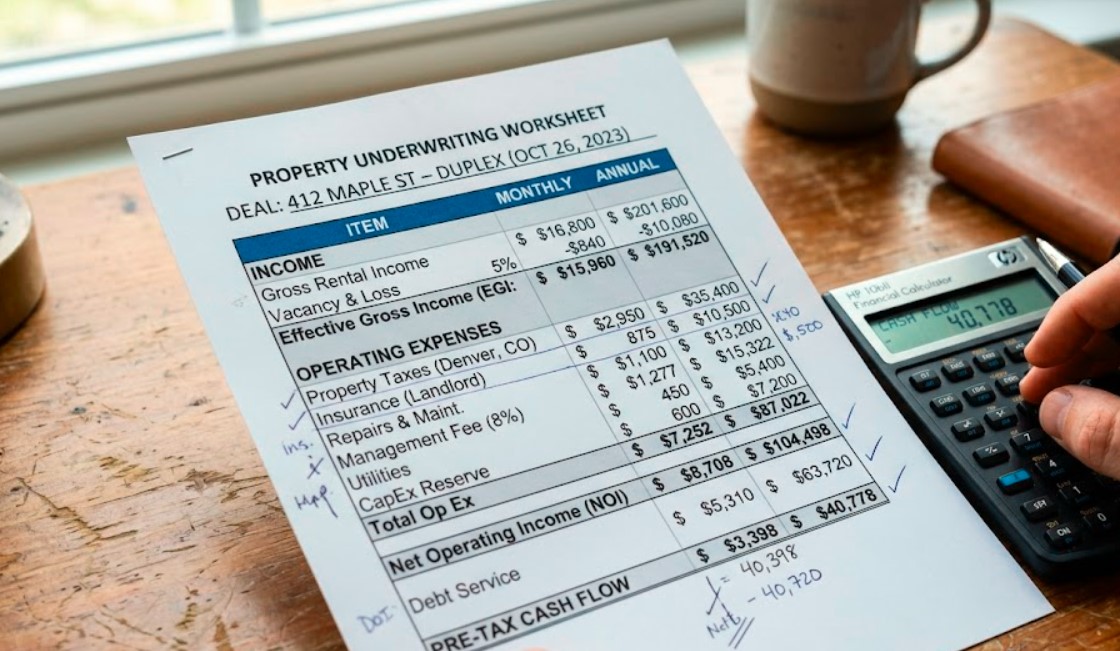
An illustrative example: a single-family Toledo rental bought for $110,000 cash, renting for $1,250 a month, owned by an investor who lives in another state. The numbers are assumptions to show scale.
| Line | Amount |
|---|---|
| Rent collected (one month vacant) | $13,750 |
| Property tax | −$2,300 |
| Insurance | −$1,200 |
| Property management (10% of collected rent) | −$1,375 |
| Repairs and maintenance | −$1,500 |
| Water, sewer and refuse (owner-paid) | −$1,072 |
| Depreciation (building portion over 27.5 years) | −$3,450 |
| Net rental profit | $2,853 |
| Toledo city income tax (2.5%) | About $71 |
| Ohio income tax (2.75%, if above the threshold) | About $78 |
| Sales tax on $800 of materials (7.75%) | About $62 |
| Taxes other than property tax | About $211 |
Illustrative only. Water figure uses Toledo's 2026 average residential bill of $89.32 a month. Depreciation assumes $95,000 of the price is building. Federal tax not shown.
The takeaway: among Toledo rental taxes, city and state income taxes are small on a cash-flowing house, often under $200 a year combined, while property tax runs about ten times that. Filing on time matters more than the amount. Full operating costs, beyond taxes, are broken down in our guide to the cost of owning a rental property in Toledo.
Toledo Rental Taxes: Mistakes Out-of-State Owners Make
- Skipping the Toledo return because the property "didn't make money." Reporting the loss on time keeps your city account current, and unfiled years tend to surface right when you need a city permit or want to sell.
- Assuming the LLC handles it. A single-member LLC is usually reported on the owner's returns. Ask your CPA how your structure files with Toledo and Ohio. Our guide to an LLC for rental property in Ohio covers the basics.
- Underwriting with last year's property tax. After a sale, the bill can change, and the HB 186 phase-out adds to it every year through 2029.
- Forgetting lodging tax on a furnished or short-term rental.
- Letting the water bill slide. In Toledo, the water account stays in the owner's name, and unpaid balances follow the property.
FAQ
What is the Toledo city income tax rate?
Toledo's municipal income tax rate is 2.5%. It applies to wages earned in Toledo, to Toledo residents' income, and to net profit from rental property located in Toledo, regardless of where the owner lives.
Do I have to file a Toledo tax return if I own a rental but live out of state?
Yes. Toledo taxes net profit from rental property located in the city no matter where the owner lives. Nonresidents file the city's nonresident individual return and report profit or loss from their Toledo properties only.
What is the sales tax rate in Lucas County, Ohio?
The combined sales tax rate in Lucas County is 7.75%, made up of Ohio's 5.75% state rate, a 1.5% county rate and a 0.5% transit levy. Residential rent isn't subject to sales tax, but materials, appliances and some services a landlord buys are.
Is rental income taxed in Ohio for nonresidents?
Generally yes. Rent from Ohio property is Ohio-source income, so a nonresident owner files an Ohio IT 1040 and pays Ohio tax on that income. For 2026, Ohio's rate is a flat 2.75% on income above $26,050.
Austin works with investors who own Toledo rentals from all over the country, and he can connect you with local CPAs and property managers who handle Toledo rental taxes and filings every year.
Talk to Austin About Owning in Toledo
Note: Austin Cleghorn is a Realtor, not a CPA or tax attorney. Rates and rules change; confirm with the City of Toledo Division of Taxation, the Ohio Department of Taxation and your tax professional.
Sources
- City of Toledo: 2025 Individual Nonresident Tax Return
- City of Toledo: Nonresident return instructions (rental income)
- EY Tax News: Ohio implements a flat 2.75% income tax in 2026 (HB 96)
- Avalara: Lucas County, Ohio sales tax rate
- Lucas County: Hotel/Motel Occupancy Tax
- City of Toledo: Short-Term Rental Permit
- Ohio Legislative Service Commission: lodging tax and the five-room hotel definition


