Selling in Toledo? See every seller closing cost in Lucas County for 2026, from the...
Read MoreQuick recap in case you need it: BRRRR stands for Buy, Rehab, Rent, Refinance, Repeat, a way to recycle the same capital into multiple properties instead of tying it up in one. If you want the full 101-level explanation, start with BRRRR method explained. This page assumes you already know the concept and want the real mechanics.
What follows is the BRRRR strategy in Toledo, worked all the way through: what to buy, how to estimate rehab accurately, how the cash-out refinance actually works, and a full hypothetical deal with numbers you can stress-test. No inflated projections, no guaranteed outcomes, just the process as it actually runs.
Why Toledo Works for BRRRR
BRRRR only works where the math supports it, and Toledo’s fundamentals line up well with what the strategy needs:
- Affordable entry prices mean the total cash-in (purchase plus rehab) stays low enough that a refinance can realistically return a large share of your capital.
- Forced-appreciation potential is real in Toledo’s older housing stock, where a distressed property brought up to a solid rental standard can create meaningful spread between total cost and after-repair value.
- Rent-to-price ratios that support cash flow even after a cash-out refinance loan is in place, rather than a property that only cash-flowed before you pulled equity out.
None of that is a promise. It’s a description of why the underwriting logic tends to work here more often than in expensive, appreciation-driven metros. Every deal still has to be run on its own numbers. For the broader case, see why Toledo works for cash flow and is Toledo a good place to invest.
Step 1: Buy
B – Buy
A good BRRRR candidate in Toledo is a property priced below its stabilized value because of condition, not location. You’re looking for:
- Distressed or underpriced properties where cosmetic or moderate mechanical issues are scaring off retail buyers, not structural or foundation problems that erase your margin.
- Off-market sourcing – on- and off-market deals surface the properties that never reach a bidding war on the open market.
- Solid neighborhood class – the rehab has to land in a block where the resulting rent and value are supported by real comparables, not just your finished product.
Initial underwriting at this stage is a rough pass: estimated rehab, estimated ARV, and a gut check on whether the spread looks wide enough to bother inspecting formally. Precision comes next.
Step 2: Rehab
R – Rehab
Estimating rehab cost in Toledo accurately is the single highest-leverage skill in BRRRR, because every dollar you misjudge here comes directly out of your capital return later.
Break the scope into categories before pricing it:
- Systems – roof, HVAC, electrical, plumbing. Expensive, but usually predictable once inspected.
- Structural – foundation, framing. The category most likely to blow a budget if missed at purchase.
- Cosmetic – flooring, paint, fixtures, kitchens and baths. Drives rent appeal but is the easiest to overspend on relative to rent ceiling.
- Code and safety – anything required to legally rent the unit.
Common budget-blowers: hidden water damage behind finished surfaces, outdated electrical panels that need a full upgrade, and change orders once walls are opened. Get an actual contractor walkthrough and written quote before you finalize an offer, not a guess from photos, and build in a contingency, commonly in the range of 10 to 20 percent of the rehab budget, for what the inspection didn’t catch.
Step 3: Rent
R – Rent
The goal here is leasing at a rent that’s supported by real comparables, not the number that made your spreadsheet work. Two forces are in tension:
- Property condition vs. rent ceiling. Every neighborhood has a realistic top rent regardless of finish quality. Over-improving past that ceiling doesn’t raise rent, it just raises your rehab cost.
- Rent comps. Pull actual comparable rentals in the immediate area, not citywide averages, to set an achievable and defensible number.
Getting the property tenant-ready and leased quickly also matters for the next step, since lenders want to see the property performing, not sitting vacant, before they’ll refinance it as a stabilized asset. Vetted local property management earns its fee here by placing a qualified tenant fast rather than taking the first applicant.
Have a specific rehab candidate in mind?
Get it underwritten with real rehab, rent, and refinance numbers before you make an offer.
No pressure. No obligation.
Step 4: Refinance
R – Refinance
The cash-out refinance rental Toledo step is where the strategy either pays off or disappoints, and it runs on three factors:
- Seasoning period. Lenders commonly require a period of ownership, often several months, before they’ll refinance based on the new appraised value rather than your purchase price. Confirm the current requirement with your lender before you plan a timeline around it.
- The ARV appraisal. After-repair value is only real once an appraiser confirms it. Your rehab receipts don’t set the number; comparable sales do.
- LTV considerations. Investment property cash-out refinances typically lend against a percentage of appraised value, not 100 percent, so a portion of your equity stays in the deal by design.
What determines how much capital you get back is simple in concept and unforgiving in practice: appraised value, multiplied by the lender’s LTV, minus the new loan payoff and closing costs. Underestimate ARV or overspend on rehab and less capital comes back than planned – which is exactly why steps one and two deserve so much discipline.
Step 5: Repeat
R – Repeat
A well-executed BRRRR returns most or all of your original capital, leaving you with a cash-flowing rental and the same money ready to deploy again. That’s the entire point: recycling capital instead of it sitting in one property indefinitely.
In practice, scaling this way means each deal has to actually work on its own before you repeat it. A deal that only “sort of” cash-flows after refinance isn’t a foundation for deal two, it’s a liability you’re carrying into it. Discipline on deal one is what makes deal five possible.
Worked Example: A Hypothetical Toledo BRRRR Deal
Illustrative example – not an actual Toledo listing
Round numbers, for illustration only. Every figure below would need to be verified against a real property, contractor quotes, and current lender terms.
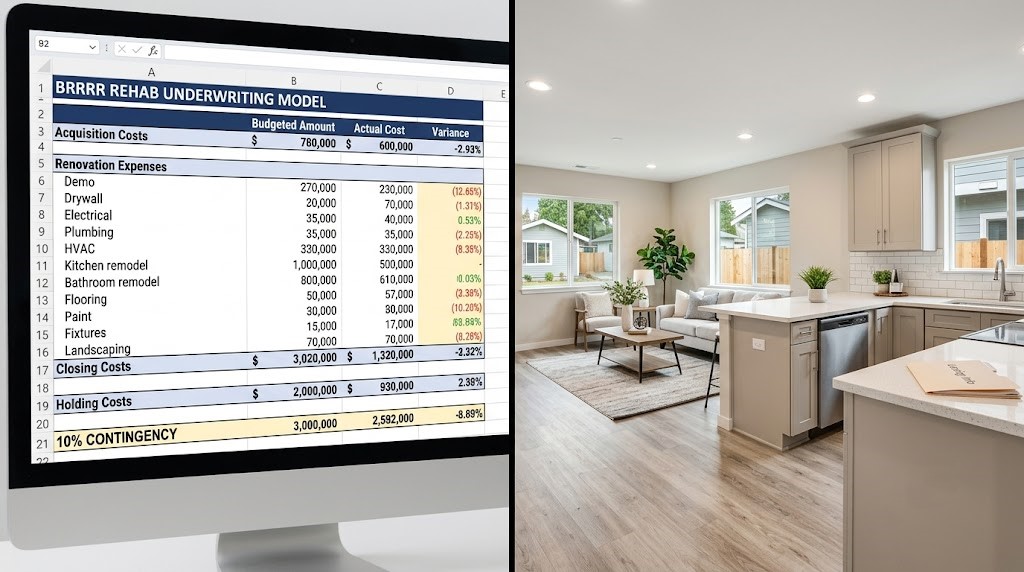
| Purchase price | $80,000 |
| Rehab budget (incl. 15% contingency) | $40,000 |
| Closing & holding costs during rehab | $5,000 |
| Total cash in | $125,000 |
| After-repair value (ARV, appraised) | $165,000 |
| Refinance loan amount (at illustrative 75% LTV) | $123,750 |
| Cash left in deal after refinance | ~$1,250 |
| Monthly rent achieved | $1,350 |
| Estimated monthly cash flow (post-refinance, all expenses) | ~$140 |
Read the mechanics, not the specific dollars: total cash in was $125,000, the ARV appraisal came in meaningfully above that at $165,000, and a 75% LTV refinance returned nearly all of the capital while leaving the property cash-flowing. Change any input – a $10,000 rehab overrun, an ARV that appraises $15,000 lower, a lower LTV – and the amount of capital recycled shifts accordingly. That sensitivity is exactly why every stage above gets its own underwriting discipline rather than a single guess at the start.
Common BRRRR Mistakes in Toledo
- Underestimating rehab. The single most common way a BRRRR deal disappoints. Get real contractor quotes, not a spreadsheet guess.
- Over-improving for the rent ceiling. High-end finishes in a neighborhood with a fixed rent ceiling raise cost without raising rent.
- Refinancing too early. Rushing the appraisal before the seasoning period or before the property has stabilized often produces a lower ARV than waiting would have.
- Bad contractor vetting. An unreliable contractor turns a four-month rehab into a nine-month one, and holding costs compound the entire time.
BRRRR vs. Turnkey: Which Fits You?
BRRRR recycles capital and can build forced equity faster, but it adds rehab risk, timeline risk, and appraisal risk that a turnkey purchase simply doesn’t carry. Turnkey is generally the more forgiving starting point, especially for a first Toledo deal or a first out-of-state purchase, while BRRRR tends to suit investors who already have a trusted local team and want to scale capital efficiently. Neither is universally better; the right one depends on your experience and risk tolerance. Current Toledo BRRRR properties are a good place to see what real candidates look like.
Not sure if BRRRR is the right move for you?
Talk through your experience, capital, and risk tolerance before you commit to a rehab.
No pressure. No obligation.
FAQ
How much capital do I need for a BRRRR deal in Toledo?
You need enough to cover the purchase, the full rehab budget, and holding costs during the rehab and lease-up period, typically financed with a short-term or hard-money loan plus your own cash, since most permanent lenders will not finance a distressed property. A successful refinance later returns a meaningful portion of that capital, but you should plan and qualify as though none of it comes back, since the return of capital depends on the appraisal and lender terms at that time.
How long does a BRRRR deal typically take in Toledo?
From purchase to a stabilized, refinanced rental, many BRRRR deals run several months to about a year, depending on rehab scope, contractor availability, lease-up time, and the lender’s seasoning requirement before a cash-out refinance. Lenders commonly require a seasoning period, often several months of ownership, before they will refinance based on the new appraised value rather than the purchase price. Build a realistic timeline rather than assuming the fastest case.
What is a good ARV-to-purchase-price ratio for BRRRR?
There is no single number that fits every deal, but investors commonly look for enough spread between total cash in (purchase plus rehab) and after-repair value (ARV) that a refinance at a typical investor LTV can return most or all of the capital invested. The right ratio for a specific property depends on rehab cost accuracy, comparable sales, and current lender terms, so treat any ratio as a screening tool and confirm it with a full underwriting pass.
What LTV can I expect on a BRRRR cash-out refinance?
Investment property cash-out refinances commonly land in a loan-to-value range in the mid-to-upper 70s percent of appraised value, though exact terms vary by lender, loan program, and borrower profile. The appraisal, not your rehab receipts, sets the value the loan is based on, which is why accurate ARV estimation before you buy matters as much as the rehab itself. Confirm current LTV and rate terms with a lender before underwriting a specific deal.
Should my first deal be a BRRRR or a turnkey property?
Turnkey is generally the safer entry point for a first deal, since it removes rehab risk while you learn the market and build your team. BRRRR can recycle capital faster and build forced equity, but it depends on accurate rehab budgeting and a reliable contractor, and mistakes are expensive to unwind. Many investors complete one or two turnkey deals first, then move into BRRRR once they trust their local team.
Evaluate a Real BRRRR Candidate
Austin Cleghorn is a Toledo investor-friendly Realtor with 4+ years in this market, 500+ properties sold, and a 6-year U.S. Army background. He sources on- and off-market Toledo properties and underwrites every deal with real rents, taxes, rehab, and projected ROI, helping investors, including out-of-state clients, execute BRRRR deals to recycle capital and scale remotely.
No pressure, no guesswork. Schedule a consultation to evaluate a specific BRRRR candidate property or see current off-market opportunities in Toledo. For the full underwriting approach behind these numbers, see the ROI and numbers guide, and if you’re executing remotely, the out-of-state investors guide covers the full remote process.